
Measuring what matters in community marketing.
Reach is a vanity metric. Here's the framework we use at ernest to prove community ROI to your CFO.
 Marguerite Japy, Co-founder & CEO · April 9, 2026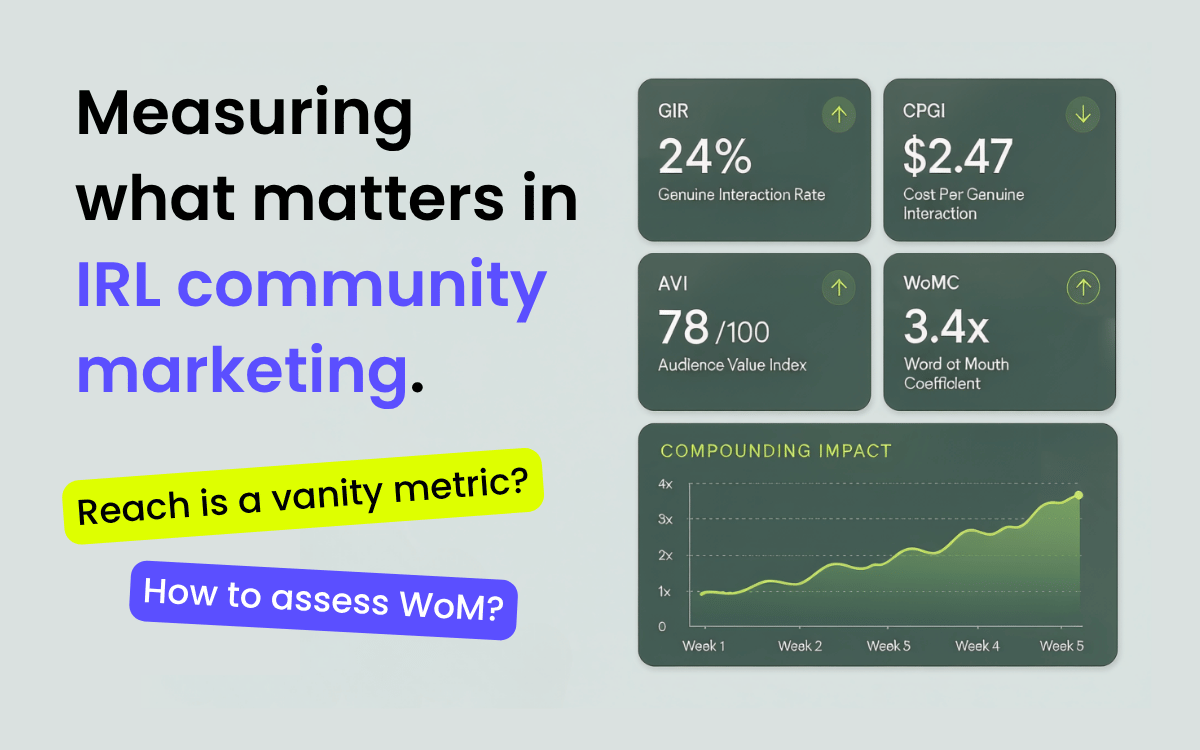
If you can't measure it, you can't defend the budget next quarter. Community marketing has a trust problem with finance teams, and it's a fair one: for years, brands have reported on community activations the same way they report on media buys (impressions, reach, follower growth). Those numbers don't hold up when a CFO asks what any of it actually returned. Reach is a vanity metric because it measures exposure, not belief. A community activation that reaches 5,000 people and genuinely moves 200 of them is worth more than one that reaches 50,000 and moves none. The problem is that "reached 50,000" looks better on a slide, even though it's the weaker result.
At ernest, we replace reach with four numbers that map directly to what a CFO actually wants to know: did this work, and what did it cost to make it work.
- Genuine Interaction Rate (GIR): the percentage of community members who did something (showed up, tried the product, posted about it), not just saw it.
- Cost Per Genuine Interaction (CPGI): total activation cost divided by genuine interactions. Directly comparable to CAC, in a currency finance already understands.
- Audience Value Index (AVI): a weighted score of how much a community's engagement is worth, based on trust and intent, not just headcount.
- Word of Mouth Coefficient (WoMC): how many additional people each engaged member brought in. The compounding return that reach-based reporting misses entirely.
Put together, these four numbers turn a community activation into a line item a CFO can actually evaluate: cost, conversion, and multiplier effect. That's the difference between "community marketing felt good" and "community marketing returned X for every dollar spent." Only one of those survives a budget review.
Frequently asked questions
How do I measure community marketing ROI without relying on impressions?
Track Genuine Interaction Rate (GIR) instead of reach: the percentage of community members who actually did something (attended, tried the product, posted about it) rather than passively saw it. Pair it with Cost Per Genuine Interaction (CPGI), which turns activation spend into a CAC-equivalent number finance already knows how to evaluate.
What hard metrics can I bring to a CFO on experiential or community marketing spend?
Four numbers, not one: Genuine Interaction Rate (GIR) for how many people did something real, Cost Per Genuine Interaction (CPGI) as the cost-per-outcome, Audience Value Index (AVI) for the trust-weighted quality of that engagement, and Word of Mouth Coefficient (WoMC) for the compounding reach each engaged member generates afterward. Together they read like a CAC/LTV table, not a reach report.
What should I put in a finance-facing report on community marketing performance?
Skip reach and impressions entirely, they do not survive a budget review. Report GIR, CPGI, AVI, and WoMC per activation, then roll them up quarter over quarter so finance can see cost-per-outcome trending down as the community channel matures, the same way they would track CAC on any other channel.
Is community marketing measurable the same way as paid ads?
Not with the same metrics, but with the same rigor. Paid media reports impressions and CPM; community marketing should report genuine interactions and cost per genuine interaction. The unit changes, the discipline of tying every dollar to an outcome does not.