
What a community marketing budget actually looks like, line by line
No rate card, no invoice you can copy. Here is what a community marketing budget is actually made of, what drives each number, and the five costs that never make the first draft.
 Marguerite Japy, Co-founder & CEO · September 3, 2026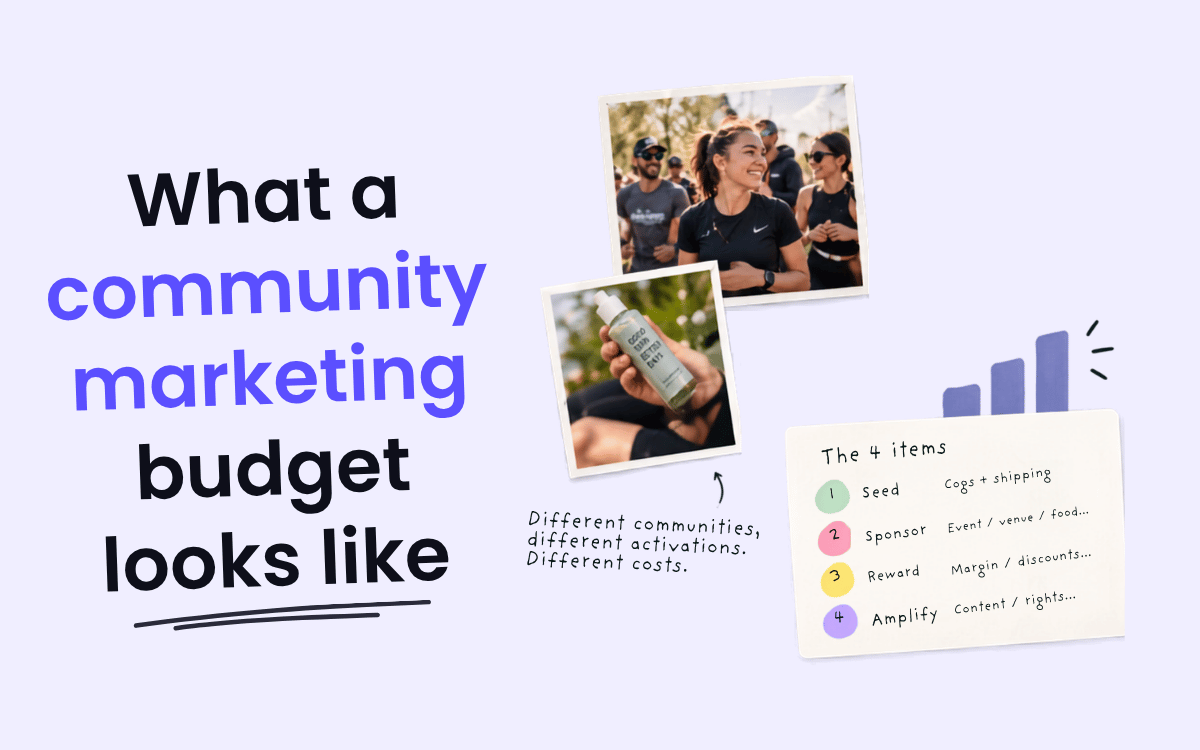
Every marketing manager who gets interested in community marketing asks two questions, always in the same order. First, does this actually work. Then, roughly four seconds later, what does it cost. The first question has good answers now. The second one usually gets a bad one, because most of what's written about community marketing either quotes a single sponsorship fee as if it were a channel budget, or refuses to put numbers on anything at all.
Neither is useful when you're the person who has to defend a line in next quarter's plan. So here is the honest version: what a community marketing budget is actually made of, what drives each number up or down, and the costs that never make it into the first draft.
Why there is no rate card, and why that isn't evasion
Paid social has a price because you are buying an auction slot. There is inventory, there is a clearing price, and the platform will quote it to you before you spend anything. Community marketing has no equivalent, because you are not buying inventory. You are agreeing terms with a specific group of people who were not for sale in the first place.
A 40-member trail running club in Lyon and a 2,000-person supper club network in Paris are not two sizes of the same product. They want different things, they can offer different things, and the same 3,000 euros buys something completely different in each. That is not a pricing problem to be solved, it is the thing that makes the channel work. The moment community access has a standard rate card, it starts behaving like the media buying it was supposed to replace.
What this means practically is that cost is driven by what you're asking for, not by how many people will see it. That inverts the instinct paid trains into you. Reach is the cheap part here. The expensive parts are physical product, someone's Saturday, and the rights to whatever gets made afterwards.
The four line items
Most community budgets break into four activation types, and they behave very differently on a spreadsheet.
- Seed. Product seeding is mostly your own COGS plus shipping, which makes it the cheapest real entry point and the one finance understands fastest. You are sending actual product to actual members, usually 20 to 30 people in one community, so the cost scales with unit cost, not with audience size. A skincare brand seeding a 25-person run club is spending 25 units and a shipping run, not a media budget. Budget it at cost, not at retail value, and resist the temptation to report it at retail later.
- Sponsor. Event sponsorship is where cash actually leaves the building. You're funding something specific: the bar at a supper club, the venue for a retreat, the coffee at a Sunday run, the prize table at a padel tournament. The number tracks the real cost of the thing you're funding, not the size of the crowd, which is why a 60-person event can cost more to sponsor than a 400-person one if the 60-person one involves a venue and food. This is also the line item with the most negotiating room, because a lot of what a community needs is not money, it's the thing money would have bought.
- Reward. Ambassador programs, early access, member discounts and affiliate structures cost margin rather than cash. That makes them the easiest to get approved and the easiest to underestimate: a 20% member discount looks free until someone models it against volume. The advantage is that reward activations keep running after the activation date, which none of the others do.
- Amplify. Turning what happened into content you can actually use. Sometimes this is free because the community was going to post anyway. Sometimes it is a real production line item with a photographer, an edit and usage rights. The difference between those two outcomes is almost entirely whether you agreed the rights before the event or after it.
The costs that never make the first draft
Every community budget we see gets rebuilt at least once, and it's usually the same five things that were missing.
- Product at cost, not at retail. Seeding 30 units of a 45 euro product is not a 1,350 euro campaign. Budget the COGS, report the COGS.
- Shipping, and the version where it goes wrong. Sizes, returns, the four packages that never arrive. Small numbers, but they are not zero and they always surprise.
- The community leader's time. The person running the club is doing real work: coordinating members, hosting, chasing photos. Communities that get compensated for that show up differently from communities that don't, and this is frequently the single highest-leverage 200 euros in the whole budget.
- Content rights. Deciding after the fact that you'd like to run the event photos as paid creative is how a free activation becomes an expensive negotiation.
- Your own team's coordination time. This is the real one. Sourcing communities, briefing them, chasing logistics and getting data back is weeks of someone's calendar per campaign if you're doing it yourself. It doesn't show up as spend, so it never gets counted, and it's the reason most brands run two activations and quietly stop.
Building an actual quarter
A single activation is a data point, not a channel. The budget that teaches you something covers two or three activations in one quarter, in communities that are different enough to compare.
The practical shape: one seeding activation to get product into hands cheaply and generate baseline sentiment data, one sponsorship where real cash goes into something visible, and one reward or ambassador structure that keeps running after the other two finish. Different cost profiles, different time horizons, one quarter, one comparison.
For where that money comes from, we've argued before for moving 10 to 15% of paid social spend rather than asking for new budget. The reallocation framing survives a budget meeting that the incremental-ask framing does not, and at that size you're testing a channel without betting the plan on it.
Comparing it to paid without cheating
Here is where most community budgets lose the argument they should have won. A community activation gets defended with reach numbers, because reach is the number everyone already has, and reach is exactly the metric where a 25-person run club looks pathetic next to a paid campaign.
If you compare a community activation to paid on impressions, community loses every time and deserves to. The comparison only works on the metrics where the difference is real: what share of the people reached actually engaged with intent, what each of those genuine interactions cost you, and whether people were still talking about the brand three weeks later. Cost per genuine interaction against CPM is not a fair fight in either direction, and pretending it is a like-for-like comparison is how these budgets get cut in year two.
Build the numbers in that shape from the first activation, not from the third, when someone senior asks.
Frequently asked questions
What's a realistic first community marketing budget?
Enough for two or three activations in one quarter rather than one big moment. For most consumer brands that lands somewhere between a single influencer post and a month of paid social, which is usually a smaller number than the marketing manager expects and a harder number to defend without the right metrics.
Is product seeding really cheaper than paid social?
On cash out the door, usually yes, because you're spending COGS rather than media. On total cost it depends entirely on whether you count your team's coordination time, which most brands don't until the second quarter.
How much does it cost to sponsor a community event?
It tracks what you're actually funding: a venue, food, prizes, a photographer. A small event with real logistics can cost more to sponsor than a larger one without them, so ask what the community actually needs before assuming the number scales with headcount.
Should I pay community leaders directly?
Compensating the leader's time is usually the highest-return small line in the budget. Whether that's cash, product, or a share of an affiliate structure depends on the community, and most leaders will tell you plainly which one they'd prefer.
How do I get this approved when the CFO only trusts paid numbers?
Frame it as a reallocation from paid social, not a new line, and commit up front to reporting genuine interest rate, cost per genuine interaction and word of mouth rather than reach. Numbers in that shape survive a budget review. Reach numbers do not.